Lens Maker Formula For Concave Lens / Derive Lens Maker's formula for a convex lens. - Applying sign convention, for convex lens, we write, 1/u + 1/v = 1/f.
Lens Maker Formula For Concave Lens / Derive Lens Maker's formula for a convex lens. - Applying sign convention, for convex lens, we write, 1/u + 1/v = 1/f.. What are the characteristics of the image formed if the object distance is 15 cm? Place a thin lens (which is made of one convex surface and one concave surface) between two refractive indices. Lens maker's formula (concave lens), unit 6, optics, class 12th physics. Geeta geeta 3 years, 6 months ago. Applying sign convention, for convex lens, we write, 1/u + 1/v = 1/f.
Let 'p' be the optical centre or pole of the lens. Diverging lenses are lenses that are thinner in the center than on the edges (concave). Lens maker's formula (refraction by a lens) a relation between the focal length of a lens, radii of curvature of two surfaces and the refractive. As soon as we can, when we read that there is a diverging lens we should draw a quick sketch to remind ourselves of the details of this lens Lens maker's formula for concave lens.
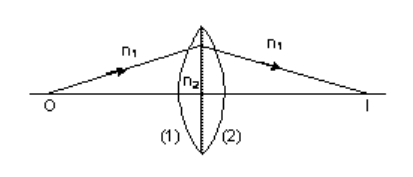
Focal length of concave lens is negative.
Students will learn how light behaves when passing through converging and diverging lenses. Now draw a line parallel to the principle axis from the object. A lens maker formula may be defined as the formula which gives. The detailed concept is given in this article so that you can understand this you all have read about lens makers formula so you can now see that what we are calculating there is actually the power of the lens. Where bo = u and di = v. It is relation between focal length, radii of curvature, refractive index of material of lens and refractive index of. This formula is applicable for any two lenses, both concave or convex or concave and convex lenses in contact. What are the characteristics of the image formed if the object distance is 15 cm? Since it is a concave lens, the light rays coming from the object will pass through the lens and diverge away from the focus. Set the concave lens surface in same manner as convex lens surface with principal axes of the lenses coinciding. Lens maker s formula and lens formula. Consider an object o placed on the principal axis of the thin. At what distance should the object from the lens be placed so that it forms an image at 10 cm from the lens?
Lens maker's formula (concave lens), unit 6, optics, class 12th physics. Place a thin lens (which is made of one convex surface and one concave surface) between two refractive indices. Where bo = u and di = v. Lens maker s formula and lens formula. Ray optics and optical instruments topic name:

Geeta geeta 3 years, 6 months ago.
Where bo = u and di = v. Lens maker's formula for concave lens. Set the concave lens surface in same manner as convex lens surface with principal axes of the lenses coinciding. Let r2 be radius of curvature of second surface of the lens. The rules for ray tracing for thin lenses are based on the illustrations included in this section: The above video provides you with the proof of lens maker formula for concave lens for more videos stay tuned to study extent. A lens maker formula may be defined as the formula which gives. Consider a ray ad parallel to principal axis falling onto a concave lens of focal length f and being diverged by passing through e. Keep the given convex lens of known focal length, f1, in contact with the concave lens whose focal length to be determined. Consider an object o placed on the principal axis of the thin. With a concave lens, the image will always be diminished, the right way up and virtual. A ray entering a converging lens parallel to its axis. To set the image needle at i'.
Set the concave lens surface in same manner as convex lens surface with principal axes of the lenses coinciding. Which is lens formula for thin lens. An object is placed in front of a convex lens with a focal length, f of 10 cm. Ray optics and optical instruments topic name: Lens maker's formula relates the focal length, radii of curvature of the curved surfaces, and the refractive index of the transparent material.

(i) the lens is thin and all the distances are measured from the optical centre of the lens.
A lens will be converging with positive focal length, and diverging if the focal length is negative. Since it is a concave lens, the light rays coming from the object will pass through the lens and diverge away from the focus. Geeta geeta 3 years, 6 months ago. Lens maker's formula (refraction by a lens) a relation between the focal length of a lens, radii of curvature of two surfaces and the refractive. The radii of curvature here are measured according to the cartesian for a double convex lens the radius r1 is positive since it is measured from the front surface and extends right to the center of curvature. It is a relation that connects the focal length of a lens to radii of curvature of the two surfaces of the lens and the refractive index of the material of the lens. Lens maker's formula for concave lens. Lens maker's formula (concave lens), unit 6, optics, class 12th physics. So we can conclude that a convex lens need not necessarily be a converging and a concave lens diverging. Generally, lenses can be classified as converging (convex) and diverging lenses (concave). Keep the given convex lens of known focal length, f1, in contact with the concave lens whose focal length to be determined. Place a thin lens (which is made of one convex surface and one concave surface) between two refractive indices. Diverging lenses are lenses that are thinner in the center than on the edges (concave).


Komentar
Posting Komentar